
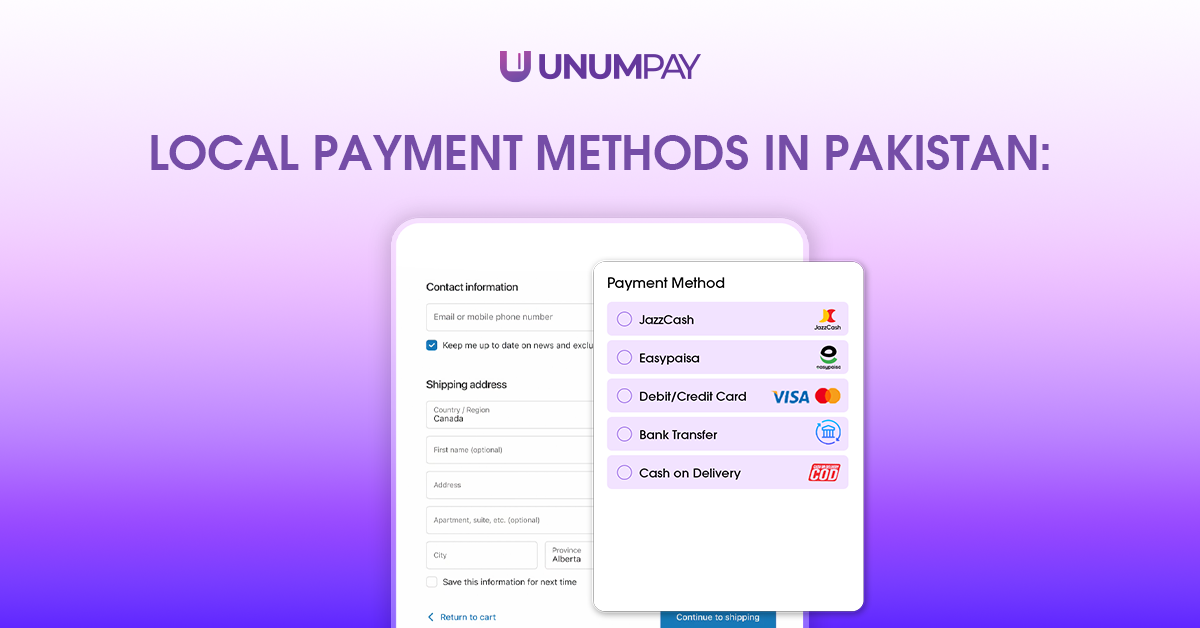
Quick answer: Pakistani online shoppers use a mix of mobile wallets, debit and credit cards, bank transfers, and Cash on Delivery — and no single method dominates across all segments. For Shopify merchants in Pakistan, offering the right combination of local payment methods is one of the most direct ways to improve checkout trust, reduce cart abandonment, and grow sales. This guide breaks down each method, what it means for your store, and how to build a payment mix that works.
- 1.What Payment Methods Do Pakistani Customers Prefer Online?
- 2.Why Local Payment Methods Matter for Shopify Stores
- 3.Wallets, Cards, Bank Transfer, and COD Explained
- 4.Which Methods Build More Trust at Checkout?
- 5.How Merchants Should Decide Their Payment Mix
- 6.How UnumPay Supports a Multi-Method Setup
- 7.Frequently Asked Questions
- 8.The Bottom Line
What Payment Methods Do Pakistani Customers Prefer Online?
Pakistan's digital payments landscape has changed significantly over the past few years. Mobile wallet adoption has surged, digital payments infrastructure has expanded with initiatives like Raast, and more buyers than ever are completing purchases online. But the picture is not uniform across all customer segments.
Pakistani online shoppers broadly fall into a few distinct payment preference groups:
- Mobile wallet users: Younger buyers and those in smaller cities increasingly rely on JazzCash and Easypaisa for everyday digital transactions. These wallets are deeply embedded in daily financial life for millions of Pakistanis who may not have or regularly use a bank card.
- Card users: Urban, higher-income buyers — particularly in Karachi, Lahore, and Islamabad — tend to pay with Visa or Mastercard debit or credit cards. Cards remain the dominant method for higher-value purchases.
- Bank transfer users: Direct bank transfers are common for business buyers and larger orders where the buyer wants a clear, traceable record of the transaction.
- COD users: Cash on Delivery remains significant across Pakistan, particularly for first-time online buyers, buyers in smaller cities, and categories like fashion and lifestyle where return rates are higher. COD reduces perceived risk for buyers who are not yet fully comfortable with digital payments.
- QR payment users: QR-based payments are growing, supported by initiatives like Raast — Pakistan's instant payment system developed by the State Bank of Pakistan. While still emerging in e-commerce, QR payments are increasingly relevant for merchants tracking where digital payment behaviour is heading.
Understanding which of these groups makes up your core customer base is the starting point for any sound payment method decision.
Why Local Payment Methods Matter for Shopify Stores
Shopify Payments is not available in Pakistan, so every Pakistani Shopify merchant is already working with third-party payment providers. The question is not simply whether to accept digital payments — it is which local payment methods to prioritise, and why.
The answer comes down to three things: checkout trust, customer payment preference, and conversion rates.
- Checkout trust: Pakistani buyers — particularly first-time online shoppers — are more likely to complete a purchase when they see a payment option they already use and recognise. Seeing JazzCash or Easypaisa at checkout does not just offer convenience. It signals that the store understands its customers and has been set up with them in mind. This is what local checkout trust means in practice, and it has a measurable effect on whether a buyer completes the order or leaves.
- Customer payment preference: Offering payment flexibility for Pakistani customers is not just a nice-to-have feature. In a market where buyer preferences vary widely by geography, age, and income level, a store that only accepts cards is invisible to a large share of potential buyers. A store that only accepts wallets will lose card users. The right setup covers multiple methods simultaneously.
- Conversion rates: Cart abandonment at the payment step is one of the most common and preventable problems Pakistani Shopify merchants face. Research consistently shows that missing payment methods are among the top reasons buyers exit at checkout. Every relevant payment method you add reduces this drop-off.
For a deeper look at how to structure your overall payment setup, see our earlier guide on how to accept payments on Shopify in Pakistan without Shopify Payments.
Wallets, Cards, Bank Transfer, and COD Explained
Here is a practical breakdown of each major payment method category relevant to Pakistani Shopify stores.
Mobile Wallets — JazzCash and Easypaisa
Mobile wallets are the fastest-growing category in Pakistan's digital payments landscape. JazzCash and Easypaisa are the two dominant platforms, each with tens of millions of registered users.
JazzCash: Operated by Jazz (formerly Mobilink), JazzCash is the most widely used mobile wallet in Pakistan. It is particularly strong among mobile-first users and buyers outside major urban centres.
Easypaisa: Operated by Telenor Pakistan, Easypaisa has a long-established presence and strong reach in smaller cities and rural areas. Many buyers use Easypaisa as their primary — and sometimes only — digital payment method.
For Shopify merchants, activating wallet payments in Pakistan means opening merchant accounts with these providers and connecting them to your store. Wallet payments at checkout are fast, familiar to users, and require no physical card.
Debit and Credit Cards
Cards remain the backbone of online payments in Pakistan for urban and higher-income segments. Visa and Mastercard are the most widely accepted networks. Most local bank gateways — including HBL, MCB, Bank Alfalah, and Meezan Bank — support card acceptance through hosted checkout solutions.
Card payments are important for:
- Higher average order values
- Business-to-consumer sales targeting urban buyers
- International customers paying in foreign currency
For any Shopify store in Pakistan, card acceptance is non-negotiable as a baseline.
Bank Transfers
Direct bank transfers are most commonly used for higher-value orders and business purchases. Buyers who prefer bank transfers often want a traceable, documented record of their payment — which is particularly relevant for B2B transactions or large consumer purchases like furniture or electronics.
Several Pakistani bank gateways support direct bank transfer integration with Shopify through third-party platforms.
Cash on Delivery (COD)
COD remains a meaningful share of transactions across most consumer product categories in Pakistan. It is especially prevalent in:
- Fashion, lifestyle, and accessories
- Smaller cities and towns where digital payment adoption is still growing
- First-time online buyers who are not yet comfortable committing to a digital transaction
Shopify has built-in COD support that can be enabled in your payment settings without a third-party provider. For merchants who want more control over COD management — such as restricting COD by geography or order value — third-party apps and platforms offer additional features.
QR Payments and Raast
QR-based payments and instant bank transfers through Raast are the emerging frontier of digital payments in Pakistan. Raast, developed by the State Bank of Pakistan, enables instant, low-cost account-to-account transfers and is increasingly being integrated into consumer-facing payment flows.
While Raast-based e-commerce payments are still developing in terms of merchant tooling, Pakistani Shopify merchants should be aware of this direction. Merchants who build a flexible, multi-method payment setup now will be better positioned to add QR and Raast-based options as they become more widely supported in Shopify-compatible integrations.
Which Methods Build More Trust at Checkout?
Checkout trust is not uniform across payment methods. Different buyers respond to different signals, and the trust value of each method depends heavily on the customer segment.
| Payment Method | Trust Signal | Best For |
|---|---|---|
| JazzCash | Familiar brand, widely used | Mobile-first, smaller cities |
| Easypaisa | Established presence, rural reach | Broader national audience |
| Cards (Visa/Mastercard) | International recognition, secure | Urban buyers, higher-value orders |
| Bank transfer | Traceable, formal | Business buyers, large orders |
| COD | Zero upfront digital risk | First-time buyers, fashion/lifestyle |
| QR / Raast | Modern, instant | Tech-savvy younger buyers |
The trust dynamic also works in reverse. If a buyer arrives at your checkout and does not see a payment method they are comfortable with, the absence of that option is itself a trust signal — a negative one. It suggests the store may not be built for customers like them.
This is why payment flexibility for Pakistani customers is not just an operational consideration. It is a brand and customer experience consideration.
How Merchants Should Decide Their Payment Mix
There is no universal answer to which payment methods every Pakistani Shopify store should activate. The right mix depends on your specific customer base, product category, and growth plans. Here is a practical framework:
- Know your buyer profile first: Who is buying from you? If your analytics or order data shows a concentration of buyers in Karachi and Lahore purchasing premium products, card acceptance should be your top priority. If you are selling across Pakistan to a broad audience at lower price points, wallets and COD deserve equal priority.
- Consider your order value: Higher average order values tend to correlate with card and bank transfer usage. Lower average order values — particularly in fashion, beauty, and everyday accessories — see stronger wallet and COD usage.
- Do not under-index on wallets: A common mistake among merchants who started with a card-focused setup is underestimating how many buyers exclusively use JazzCash or Easypaisa. Adding wallet support often produces an immediate uplift in completed orders, particularly from buyers who were previously reaching checkout and finding no suitable option.
- Plan for COD strategically: COD adds operational complexity — returns, cash handling, and failed deliveries are all higher with COD orders. But excluding it entirely can mean leaving a significant portion of potential buyers behind. Many merchants manage this by enabling COD selectively — for certain product categories, certain regions, or orders below a specific value.
- Build in redundancy: Regardless of which methods you choose, always have at least two active payment options. If one provider experiences downtime during a peak sales event, a backup keeps your store operational.
How UnumPay Supports a Multi-Method Setup
Managing multiple payment methods on a Shopify store in Pakistan means dealing with multiple merchant accounts, multiple integrations, and multiple reporting dashboards — unless you use a platform that centralises all of it.
UnumPay is a Shopify-approved payment gateway mediation platform that connects Pakistani Shopify merchants to 40+ payment providers through a single integration. Rather than installing separate apps and managing separate credentials for each provider, everything is handled from one dashboard — transaction data, success rates, reconciliation reports, and gateway management across all active methods.
For Pakistani merchants specifically, UnumPay covers:
- Mobile wallets: JazzCash, Easypaisa
- Bank gateways with hosted checkout: HBL, HBL Hosted Checkout, MCB, Bank Alfalah MPGS, Meezan Bank, BOP, Allied Bank
- Payment Service Providers: AbhiPay, Assan Pay, Swich, Neem, DirectPay
- Other payment options: Google Pay, QR Payments / RAAST
- International gateways: Stripe, Checkout.com, Authorize.net, and more
This means a Pakistani Shopify merchant can activate local wallets, bank gateways, and international processors simultaneously — with all transaction data visible in one place, and no developer required for setup.
UnumPay is trusted by 2,500+ merchants across 45+ countries, processes 80,000+ transactions per month, and carries a 4.6-star rating on the Shopify App Store. It is free to install with a transparent 0.85% per transaction fee and no monthly subscription.
Frequently Asked Questions
What are the most popular online payment methods in Pakistan?
JazzCash, Easypaisa, Visa and Mastercard cards, bank transfers, and COD are the most widely used. The right mix depends on your customer base and product category.
Is JazzCash supported on Shopify in Pakistan?
Yes. JazzCash can be connected to Shopify through a mediation platform like UnumPay and appears as a checkout option once active.
Is Easypaisa supported on Shopify?
Yes. Easypaisa is supported through UnumPay. Open a merchant account, add your credentials in the UnumPay dashboard, and it goes live on your checkout.
What is Raast and is it relevant for Shopify merchants?
Raast is Pakistan's instant payment system by the State Bank of Pakistan. E-commerce integrations are still developing, but it is an important direction for Pakistani digital payments to monitor.
Should I offer COD on my Shopify store in Pakistan?
Yes, for most stores — especially in fashion and lifestyle. Many merchants manage it selectively by geography or order value to control operational complexity.
Why do local payment methods matter for checkout trust?
Pakistani buyers are more likely to complete a purchase when they see a familiar payment option. Missing a preferred method is one of the most common reasons for checkout abandonment.
What is the difference between cards and wallets for Pakistani e-commerce?
Cards suit urban, higher-income buyers for larger purchases. Wallets like JazzCash and Easypaisa serve mobile-first buyers and smaller cities — and are often their only digital payment option.
Can I accept QR payments on Shopify in Pakistan?
QR and Raast-based e-commerce integrations are still developing. Build a flexible setup now so you can add these methods as Shopify-compatible support becomes available.
How many payment methods should I activate on my Shopify store?
At least three — card acceptance, one or both major wallets, and COD. Bank transfer rounds out the setup for higher-value orders.
Does UnumPay support all major local payment methods in Pakistan?
Yes. UnumPay supports JazzCash, Easypaisa, Pakistani bank gateways, fintech providers, and international gateways — all managed from one dashboard.
The Bottom Line
Pakistan's online payment landscape is diverse, and no single payment method covers all buyers. For Shopify merchants in Pakistan, the decision is not which one method to use — it is how to build a payment mix that reflects how your customers actually want to pay.
Cards cover urban buyers. Wallets reach mobile-first and smaller-city shoppers. COD brings in first-time buyers. Bank transfers serve higher-value and business orders. QR payments and Raast represent where the market is heading. A store with the right combination of these is better positioned to convert more buyers, build checkout trust across segments, and grow sustainably.